Brooklyn’s crowded delivery corridors, from Bay Ridge to Bushwick, see a constant stream of Amazon, UPS and FedEx vans working against tight delivery windows, and a crash involving one usually puts a corporation’s insurance on the hook rather than just the driver’s own policy. These companies carry insurance limits that dwarf what a single driver could ever carry on their own, and New York law generally follows the money back to the employer once a driver is shown to have been working a route on the clock.
Brooklyn delivery crashes tend to follow one of three patterns. A van double-parked in a travel lane forces other drivers or cyclists into a risky maneuver, a driver speeding to make up time on a tight route misses a hazard ahead, and a wide blind spot hides a pedestrian or cyclist from view during a turn. Each of those patterns points back to decisions the company made about routing, scheduling and vehicle design, not just a single moment of driver error.
How Delivery Vans Are Owned and Operated in NYC
Amazon relies heavily on Delivery Service Partners in New York City, third-party companies that hire drivers and operate vans under Amazon’s branding and route software. FedEx Ground works through a similar network of contracted providers, while UPS still employs most of its own drivers directly rather than contracting the work out. Pinning down who actually runs a given van, a small local contractor or the corporation whose logo is on the side, determines which company ends up named in a claim and how much coverage is actually on the table.
Why the Corporation Behind the Van Carries the Liability
Under the doctrine of respondeat superior, New York courts place liability on the employer for a driver’s on-the-job negligence, and a route assigned through a company’s own dispatch software falls squarely within that scope. Amazon and similar companies structure their delivery networks through layers of contracted partners partly to manage cost, but that structure rarely shields the parent corporation once control over routes, schedules and delivery targets gets traced back to it.
Pursuing that higher level of coverage sits at the core of most NY corporate carrier accident claims, since a contracted local delivery partner may carry only modest coverage on its own while the national brand behind it carries a policy built specifically for this kind of loss, along with the resources to actually pay a serious claim in full rather than fight it for years.
Double-Parking and the Crashes It Causes
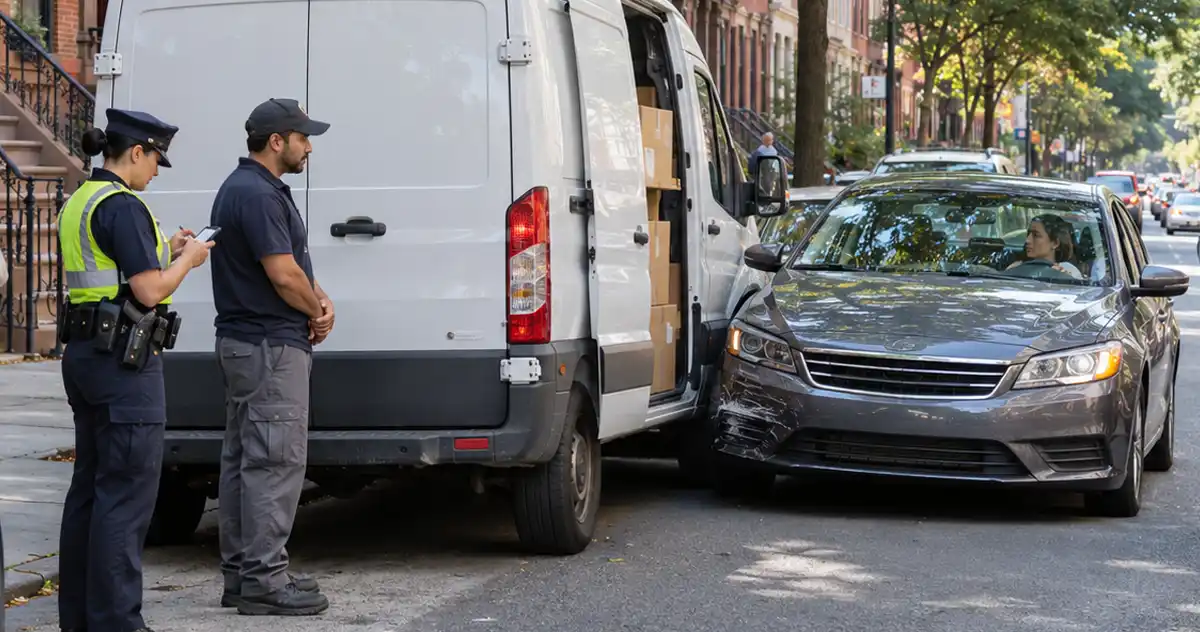
Delivery vans double-park on narrow Brooklyn streets constantly, often because there’s nowhere else to stop within a reasonable distance of a delivery address, and that habit creates its own category of crashes. A driver approaching a double-parked van has to swing wide into oncoming traffic or an adjacent lane, and a cyclist forced around the same obstacle often has far less room to react to what’s coming the other way. When a company’s own delivery software routes drivers into blocks with no legal loading zones, the resulting double-parking becomes a business decision with predictable consequences rather than an isolated mistake.
Brooklyn delivery van liability claims tied to a double-parking crash often turn on whether the company’s own routing software sent a driver into a block with no legal loading zone in the first place, and whether internal dispatch records show the company already knew that particular stretch created recurring hazards for drivers, cyclists and pedestrians alike.
Speeding and Blind-Spot Crashes on Tight Delivery Schedules
Package-per-hour targets push some drivers to speed through residential streets between stops, particularly late in a shift when a route is running behind schedule. A large delivery van also carries blind spots along both sides and directly behind the vehicle, wide enough to hide a child stepping between parked cars or a cyclist passing on the right at an intersection. Brooklyn’s mix of narrow streets, double-parked cars and heavy foot traffic makes those blind spots especially dangerous during a turn or a reverse into a loading spot.
A truck accident injury lawyer reviewing a blind-spot crash typically looks at whether the van carried the backup cameras and side mirrors required for its size class, and whether the driver had received real training on how limited that visibility actually is at low speed and tight turning angles, rather than assuming the mirrors alone would catch a pedestrian in time.
Building the Evidence File Against the Company
A claim built against the corporation behind the van draws on several sources of evidence that rarely show up in a standard police report.
Telematics and dashcam footage: Many delivery vans run forward and side-facing cameras along with GPS tracking, and that footage can show exactly how a double-park or a turn unfolded in the seconds before impact.
Delivery app dispatch records: These logs show the route a driver was assigned, how many stops were scheduled and whether the timing left any realistic room for legal parking along the way.
Driver safety violation history: Federal and company records covering prior accidents, speeding citations or blind-spot violations can establish a pattern the company knew about and did little to address.
Protecting a Claim After a Brooklyn Delivery Crash
Photographing the van’s branding, license plate and any visible company markings matters immediately after a crash, since that information helps identify which contractor or corporation actually operated the vehicle that day. A police report that captures the van’s DOT number and license plate becomes one of the fastest ways to trace ownership through whatever layer of contracting sits between the driver and the company whose name is on the side.
Seeing a doctor quickly after the crash does more than treat the injury itself, since it also shuts down one of the more common insurer tactics, arguing that a gap in care means the injury wasn’t serious or wasn’t connected to the crash at all. That tactic shows up especially often in claims against a national delivery company, where insurers are practiced at hunting for any inconsistency that lets them reduce what they eventually pay out.
When a commercial van causes the crash, the operator’s insurance and safety practices enter the case alongside the driver’s. Karns & Karns Personal Injury and Accident Attorneys can pursue the corporate policy and the records behind it. Reach us on 1-800-4-THE-WIN (1-800-484-3946) to discuss your claim.