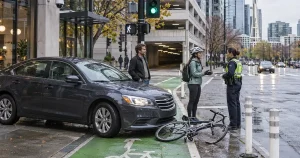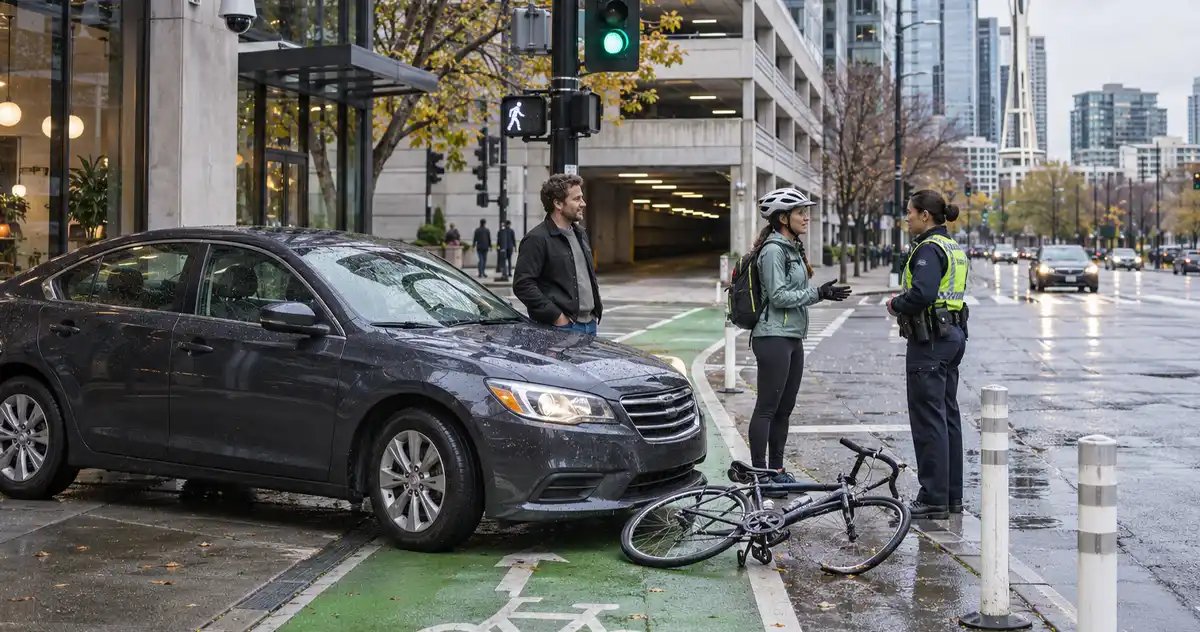
Turning collisions are the most common way riders get hurt in Downtown Seattle, and the ones drivers dispute hardest. The driver almost always says the cyclist appeared out of nowhere, and without something to check that account against, the insurer treats the crash as two competing memories. Proving what happened comes down to sight lines, signal timing and video from cameras belonging to businesses and buildings rather than to either party, and most of that footage survives days rather than months.
Downtown adds complications a rider on a suburban arterial doesn’t face. Protected lanes on Second Avenue, freight loading zones along Fourth and Fifth, transit-only lanes and signal phases built to separate bikes from turning cars all affect who had the right to be where at a given second. Which evidence answers those questions, and how fast it has to be requested, decides whether the claim rests on documentation or on the driver’s version.
Left hooks and right hooks are proven differently
Left hooks happen when an oncoming driver turns across the lane a rider is traveling straight through, usually where the driver was watching for gaps in car traffic rather than for a bicycle. Washington law requires a driver turning left to yield to any vehicle approaching from the opposite direction that is close enough to be an immediate hazard, and cyclists hold the same rights and duties as drivers. The evidence centers on approach speed, distance at the moment the driver committed to the turn, and whether anything blocked the view down the block.
Right hooks involve a driver passing a rider and then turning across the bike lane into a side street, alley or garage entrance. The question is where the vehicle sat relative to the lane before the turn and whether the driver signaled far enough ahead to matter. Second Avenue produced enough of these collisions that the city rebuilt the corridor with a protected lane and separate bicycle signal phases, and that timing data becomes proof.
What Washington law expects of drivers
Vulnerable road user provisions raise the stakes for drivers who injure cyclists through negligent driving, adding penalties and license consequences beyond an ordinary infraction. A citation under those provisions doesn’t decide the civil claim, but it shows that officers who reviewed the scene concluded the driver failed to use reasonable care. That conclusion carries weight with adjusters who might otherwise treat the crash as unavoidable.
Drivers also owe duties around bike lanes, including yielding before crossing one and looking for riders already alongside them. Where the lane is separated by a curb or parked cars, sight lines get worse and the duty to check becomes more demanding rather than less. Riders working with Seattle bike accident lawyers usually find the case turns on these details before anyone argues about medical bills.
Video is the strongest evidence and the fastest to disappear
Downtown blocks carry enough private cameras to help a rider, provided somebody asks for the recordings within the first week or two. Retention cycles run three days to a month, and no business has to hold anything simply because a crash happened outside. The sources worth identifying immediately are:
- Office lobbies, hotel entrances and parking garage exits facing the street
- Retail storefronts and restaurants with cameras pointed toward the sidewalk
- Buses and streetcars, which carry exterior cameras on fixed routes
- Delivery vans, rideshare cars and other vehicles with dashcams stopped nearby
- Construction sites, which often run security cameras covering the adjacent lane
Anyone who arranges cyclist injury legal representation early tends to have more of that footage available, because written preservation requests go out before the systems overwrite. Naming a specific date, time window and camera angle gets a better response from a building manager than a general one.
Signal timing, sight lines and physical measurements
Signal phase data from the city establishes who had a green, whether a leading bicycle interval was running and how long the turn arrow lasted. That material comes through public records channels and takes time to produce, so the request should go in early rather than after negotiations stall. Paired with video timestamps, it converts a disputed sequence into something a reconstructionist can chart second by second.
The scene itself changes with the seasons and with construction, so photographs need to show lane markings, bollards or parked vehicles, the sun’s position at that hour and how far down the block a driver could see a rider approaching. Damage patterns on the bike matter too, since impact to the front wheel and fork tells a different story about angles than damage to the rear triangle. Leaving the bike unrepaired until someone has examined and photographed it preserves that record.
Your own account and the medical file
What you write down in the first two days carries more weight than anything reconstructed later, since memory for speed, gearing and lane position fades quickly. Note your position in the lane, whether your lights were on, what you saw the vehicle do and how much distance separated you when it began turning. Names and numbers for witnesses matter more than their statements at the scene, because a follow-up call weeks later usually produces a fuller account.
Medical documentation shapes the claim as much as liability evidence does. Head impacts, wrist and clavicle fractures and shoulder injuries dominate these crashes, and some appear days later once adrenaline wears off. Treatment records describing the mechanism of injury the same way each time close off the argument that something else caused the problem. Choosing a bicycle accident law firm that requests imaging and provider narratives directly keeps that part of the file moving.
Expect an argument about your share of fault
Washington reduces a recovery by the percentage of fault assigned to the injured person rather than cutting off the claim, so insurers press hard on rider conduct. Common arguments include riding outside the marked lane, passing stopped traffic on the right, or having no front light after dusk. Each one is answerable with the same evidence that establishes the driver’s turn, which is why the footage and timing work matters twice over.
Proving a driver turned across your path takes signal timing, sight lines, and footage gathered before it cycles out. Karns & Karns Personal Injury and Accident Attorneys can request that video quickly and assemble the evidence a rider’s account needs. Contact us at 1-800-4-THE-WIN (1-800-484-3946) to discuss your claim.